


Market volatility has returned with force. As we entered 2025, many anticipated a slowdown in the economy and heightened policy-driven volatility. What has surprised many, however, is the Trump administration's renewed emphasis on tariffs. During President Trump's first term, investors witnessed the administration delay, reduce, or even remove tariffs when the stock market expressed disapproval, with these policy shifts often sparking stock rebounds.
However, this new administration seems more committed to its tariff strategy. The uncertainty surrounding where tariffs will ultimately land has sparked investor anxiety, despite potential long-term benefits such as bringing some production back onshore, enhancing national security, and raising revenue.
However, this new administration seems more committed to its tariff strategy. The uncertainty surrounding where tariffs will ultimately land has sparked investor anxiety, despite potential long-term benefits such as bringing some production back onshore, enhancing national security, and raising revenue.
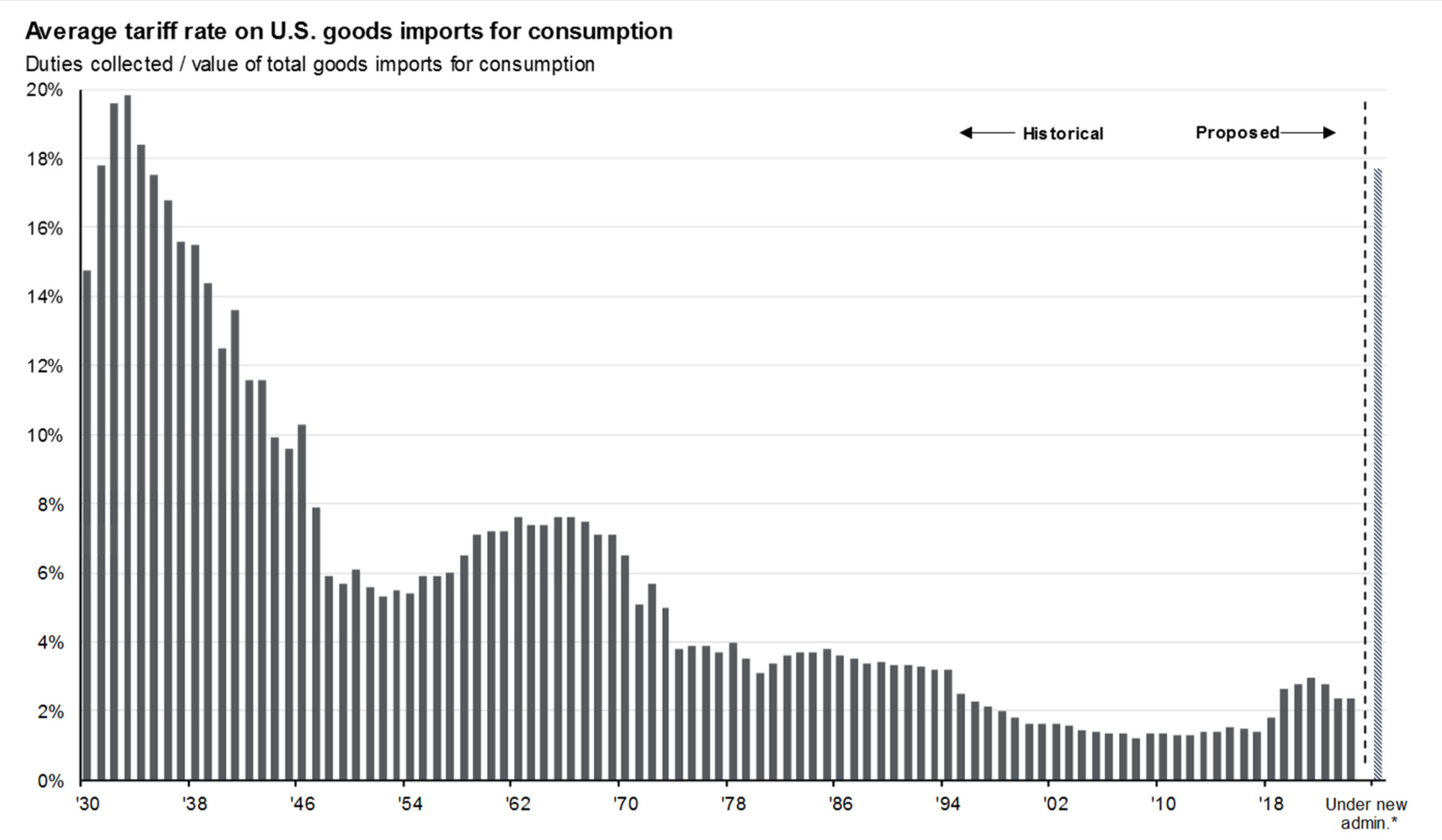
In this uncertain environment, forecasting economic growth becomes exceedingly difficult for economists, predicting profits is challenging for analysts, and planning is complicated for companies. While significant capital investment in artificial intelligence is expected to happen this year, markets had hoped that regulatory changes would spur further business investment. Yet, tariff uncertainty is currently hindering that plan. Adding to this, inflation concerns among consumers and the potential for a negative wealth effect (when declining stock values reduce consumer spending) may cause the economy to slow more than many anticipated. While a recession seems unlikely at this stage, the barrage of alarming headlines has many believing we're already in one.
How Should You Respond?
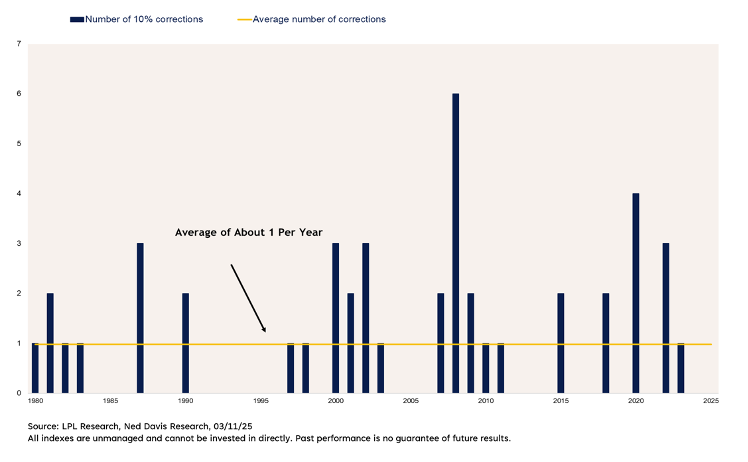
Our first piece of advice is simple: don’t panic. Volatility is a normal part of investing. It's akin to a toll that investors must pay on the road to long-term returns. The stock market experiences a correction (a drop of 10-19%) once a year on average, but it has still achieved an annualized return of 13%, including dividends, since 1980.
Here's another perspective on the value of staying invested: missing the best day of the year – often occurring during periods of market correction – can reduce your annualized return by nearly 4%. Miss the two best days, and your return could drop by almost 7%.
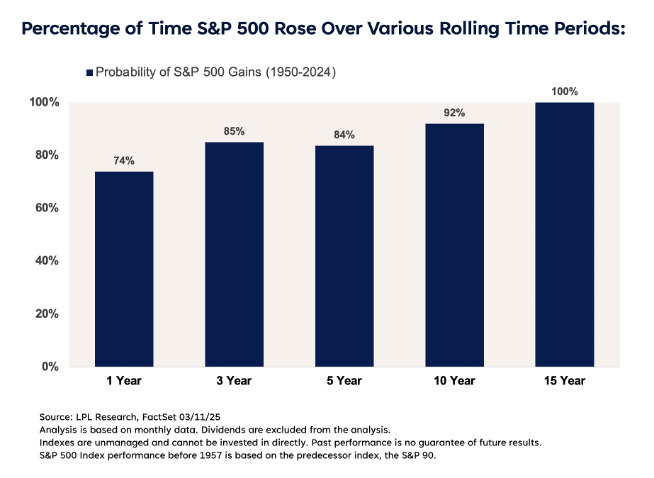
A recent Dalbar study found that investors typically underperform the overall market by about 5% due to excessive trading. While adjusting your portfolio periodically can make sense, trying to time the market by going all in or all out is a strategy that often leads to falling short of your long-term investment goals.
We understand your concerns and the temptation to sell, but we recommend resisting the urge. Remember, volatility is normal, and your long-term plan is designed to weather these fluctuations. Think back to 2024 or 2023 – in both years, the S&P 500 fell more than 8.5%, yet ended up rising more than 20%. Consider 2020 as well – the S&P 500 was down more than 30% at one point but finished the year up over 18%.
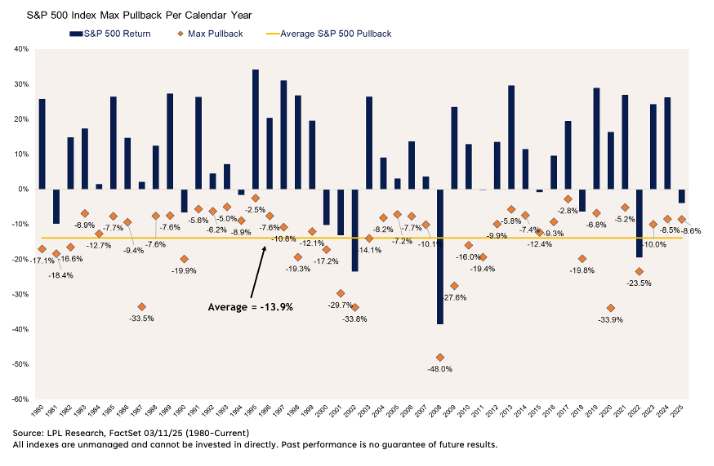
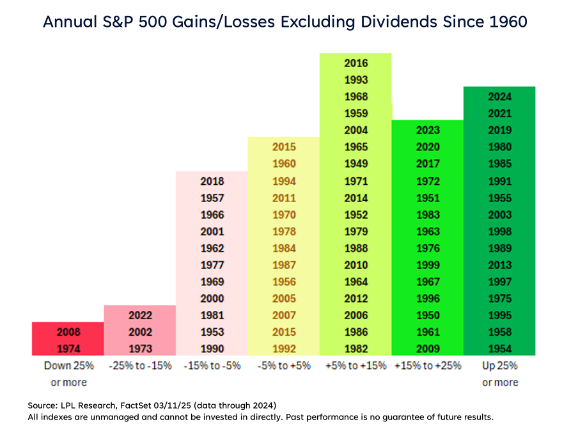
It’s easy to get caught up in the noise and fear of constant headlines. But, more often than not, the market (as measured by the S&P 500) ends up positive. Since 1960, the S&P 500 has returned a negative return greater than 5% only 16 times (about 25% of the time).
Your Portfolio Strategy
We continue to believe that the current market correction is a healthy recalibration, that the volatility we are experiencing today is the price of admission for long-term historical returns. Historically safe equity positions, such as defensive sectors, consumer staples, and utilities, have performed well during this rotation. Bond portfolios have also provided stability, delivering positive year-to-date returns. Furthermore, international equities have acted as a valuable diversifier through this volatility, providing another bright spot for portfolios.
Rest assured, your portfolio is properly allocated and diversified to support your long-term goals.
It's completely natural to feel anxious during times like these. However, we recommend focusing on your plan and letting your long-term perspective guide you through the volatility. As always, we are here to discuss any specific concerns you may have or to offer further insights into your situation.
Important Information
This material is for general information only and is not intended to provide specific advice or recommendations for any individual. There is no assurance that the views or strategies discussed are suitable for all investors or will yield positive outcomes. Investing involves risks including possible loss of principal. Any economic forecasts set forth may not develop as predicted and are subject to change.
References to markets, asset classes, and sectors are generally regarding the corresponding market index. Indexes are unmanaged statistical composites and cannot be invested into directly. Index performance is not indicative of the performance of any investment and do not reflect fees, expenses, or sales charges. All performance referenced is historical and is no guarantee of future results.
All data is provided as of March 11, 2025.
Any company names noted herein are for educational purposes only and not an indication of trading intent or a solicitation of their products or services. LPL Financial doesn’t provide research on individual equities.
All index data from FactSet.
The Standard & Poor’s 500 Index (S&P500) is a capitalization-weighted index of 500 stocks designed to measure performance of the broad domestic economy through changes in the aggregate market value of 500 stocks representing all major industries.
Bonds are subject to market and interest rate risk if sold prior to maturity. Bond values will decline as interest rates rise and bonds are subject to availability and change in price.
There is no guarantee that a diversified portfolio will enhance overall returns or outperform a non-diversified portfolio. Diversification does not protect against market risk.
Past performance does not guarantee future results.
Asset allocation does not ensure a profit or protect against a loss.
This research material was prepared by LPL Financial, LLC.
Not Insured by FDIC/NCUA or Any Other Government Agency
Not Bank/Credit Union Guaranteed
Not Bank/Credit Union Deposits or Obligations
May Lose Value
RES-0003082-0225 | For Public Use | Tracking # 708569 | # 708571 (Exp. 03/2026)